

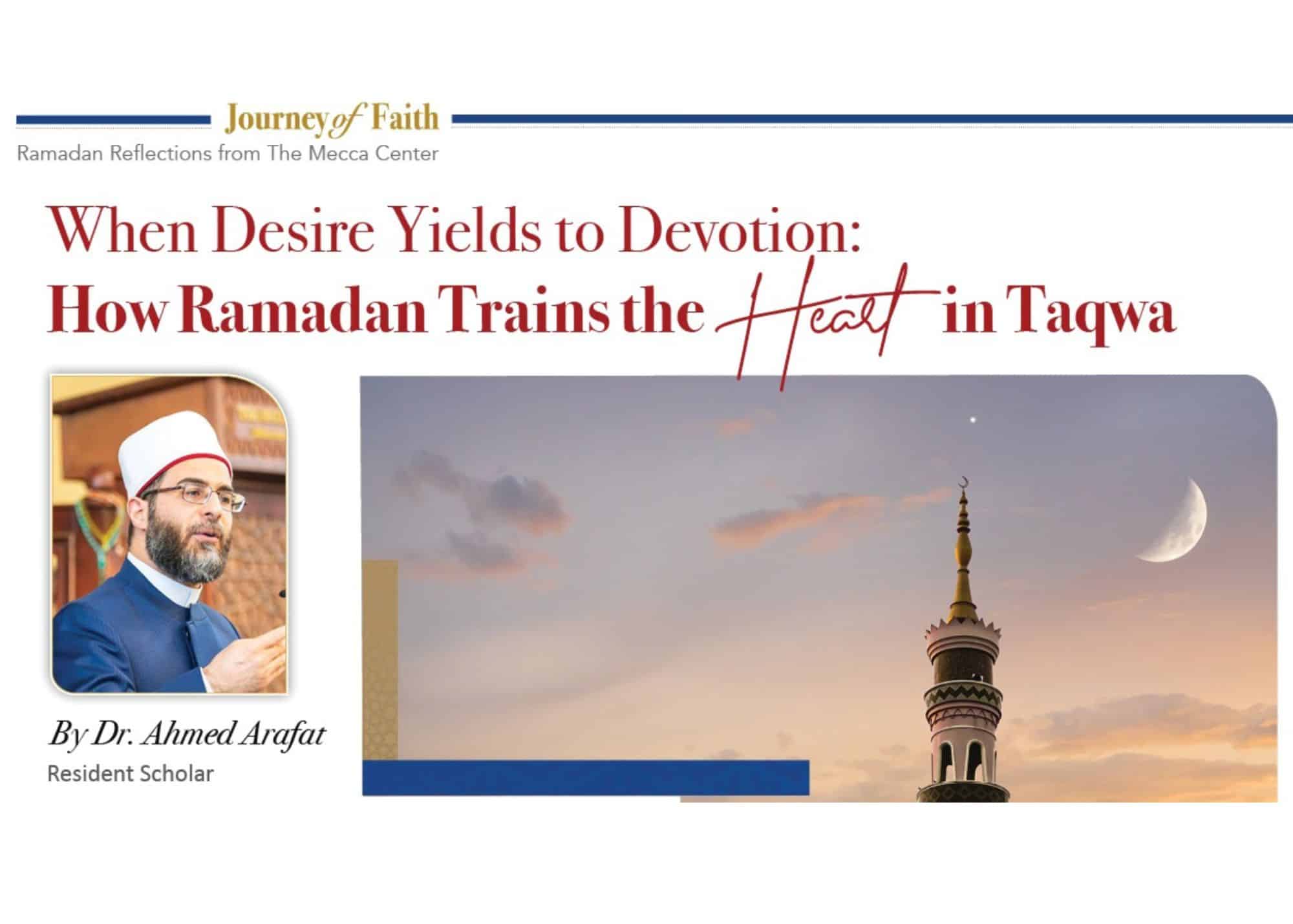
When Desire Yields to Devotion: How Ramadan Trains the Heart in Taqwa
Ramadan arrives each year as a gentle yet powerful revolution of the soul. As we welcome this blessed month, we celebrate a season of mercy, discipline, and spiritual renewal. Ramadan is not simply about refraining from food and drink; it is a divine opportunity to reshape our desires, refine our character, and draw closer to Allah ﷻ.
At the heart of fasting lies its connection to taqwa—a deep awareness of Allah that shapes both inner intention and outward behavior. Allah says in the Qur’an: :“O you who believe, fasting has been prescribed for you as it was prescribed for those before you, so that you may attain taqwa” (Qur’an 2:183). Linguistically, taqwa comes from wiqāyah, meaning protection or safeguarding. It refers to shielding oneself from harm—especially spiritual harm. In this sense, fasting acts as a protective barrier for the heart. By restraining the body, fasting strengthens the soul and trains the believer to resist sin and heedlessness. What follows is an outline of key dimensions of taqwa cultivated through fasting, along with practical action points that can serve as a “spiritual thermometer” for self-reflection during Ramadan.
1. Caring for the Soul
Imam al-Ghazali explains that physical desires are strengthened by food and bodily energy. Fasting weakens these impulses, allowing the soul to regain control and reconnect with Allah. After breaking the fast at sunset, the believer prepares for Taraweeh and increased worship, making fasting both a protective barrier and a source of spiritual nourishment. Yet when the fast is broken with excess, its spiritual benefits are diminished. Moderation in eating allows fasting to fulfill its true purpose: spiritual elevation rather than physical indulgence.
Action Point:
I commit to eating moderately at iftar, avoiding overeating, and honoring the spirit of fasting as a reduction—not an indulgence—of consumption.
2. Strengthening Willpower
Many people feel trapped in cycles of sin, believing they lack the strength to change. Fasting directly challenges this assumption and teaches a powerful lesson: self-control is possible. When hunger and thirst intensify, the fasting person learns to say “no” to even the most basic needs. This discipline proves that resisting sinful habits is possible. If one can abstain from food and water for Allah’s sake, then abandoning harmful behaviors becomes achievable. In this way, Ramadan reminds us that change is not beyond our reach—it begins with intention, discipline, and reliance upon Allah.
Action Point:
I resolve to identify specific bad habits or sins and work to abandon them, seeking Allah’s help.
3. A Season of Forgiveness
Some drift away from taqwa because the burden of past sins feels overwhelming. Ramadan comes as a divine reassurance. The Prophet ﷺ said: “Whoever fasts Ramadan with faith and seeking reward will have their past sins forgiven.” No matter how heavy the burden of sin feels, Ramadan offers a fresh beginning—a chance to return to Allah with humility and hope. Allah ﷻ calls every sinner back to Him, regardless of how far they may have strayed: “O My servants who have transgressed against themselves, do not despair of Allah’s mercy. Indeed, Allah forgives all sins.” (Qur’an 39:53) When Rabi‘ah al-‘Adawiyyah was asked whether Allah would forgive someone who had committed many sins, she replied:“He invites those who are far from Him to repent. Do you think He would turn away those who seek Him?”
Action Point:
I choose sincere repentance and thank Allah for the gracious blessing of forgiveness.
4. Cultivating Humility
Fasting reminds us of our weakness and dependence on Allah. Hunger strips away illusions of self-sufficiency and protects the heart from arrogance, no matter how comfortable our lives may be. The Qur’an warns: “Indeed, man transgresses when he sees himself as self-sufficient” (Qur’an 96:6–7).
Action Point:
I strive to remain humble before Allah and people, recognizing that blessings are a reason for gratitude—not pride.
5. Patience and Gratitude
Long fasting hours cultivate patience, while the moment of iftar awakens gratitude. Simple things—water, dates, bread—suddenly feel priceless. Ramadan reminds us not to take basic blessings for granted: water, food, health, and safety are in fact gifts deserving constant thanks.
Action Point:
I commit to keeping a personal list of blessings and thanking Allah regularly for them.
6. Generosity and Giving
The Qur’an often pairs acts of worship with social responsibility—such as prayer alongside charity. Fasting allows us to experience hunger and thirst, deepening empathy for those who endure deprivation daily. Ramadan turns this empathy into action through charity, generosity, and service. Giving purifies the heart from self-centeredness and aligns worship of Allah with care for His creation.
Action Point:
I commit to fulfilling my Zakah and increasing my charitable giving to those in need.
7. Sincerity (Ikhlāṣ)
In Islam, deeds are accepted only when done sincerely for Allah. One of the greatest lessons of fasting is sincerity (ikhlāṣ). A fasting person abstains even when no one is watching, acting solely for Allah’s pleasure. This trains the heart to seek divine approval rather than praise from people, strengthening faith and integrity.
Action Point:
I resolve to fast Ramadan seeking Allah’s pleasure alone—not social validation or cultural expectations.
8. A Faith-Nurturing Environment
Weak faith is often linked to unhealthy environments: distance from the masjid, poor companionship, and neglect of worship. Ramadan creates a spiritually immersive atmosphere—through congregational prayers, Qur’an recitation, charity, and family bonds. This environment revives faith, strengthens bonds with the masjid, and encourages righteous companionship, all of which are essential for spiritual growth.
Action Point:
I commit to distancing myself from harmful influences and strengthening my connection to the masjid and righteous company.
9. Du‘ā’ (Supplication)
It is striking that Allah’s invitation to make du‘ā’ appears directly between verses about fasting: “When My servants ask you about Me, I am near. I respond to the call of the caller when he calls upon Me.” (Qur’an 2:186) Unlike many other verses, Allah responds directly here—removing any sense of distance between the believer and their Lord. Ramadan is a time when hearts are softer and prayers rise with greater sincerity. It is a reminder that Allah is always near, listening, and responding in His perfect wisdom.
Action Point:
I commit to preparing daily supplications and trusting Allah’s wisdom in how and when they are answered.
10. Renewing Our Relationship with the Qur’an
Ramadan is commonly known as the month of fasting, yet Allah defines it as: “The month in which the Qur’an was revealed” (Qur’an 2:185). The Qur’an is the heart of Ramadan. Without reconnecting with it, we miss the essence of the month.
Five Action Points regarding the Qur’an:
- Reading: Imam Malik would suspend Hadith study in Ramadan to focus solely on the Qur’an.
- Understanding: Reflection leads to transformation. The Prophet ﷺ once spent an entire night contemplating a single verse.
- Memorizing: Begin with small portions; preservation through memorization is a unique blessing of this Ummah.
- Applying: Live by its teachings and ethics.
- Sharing: Teach what you learn—especially within your family.
I pray that Allah ﷻ grants us a Ramadan filled with mercy, forgiveness, and spiritual growth. May He keep our hearts firm upon His Straight Path, unite us in obedience, and accept our fasting, prayers, and good deeds.
Ramadan Mubarak.




Leave a Comment